
SCDC Releases Associated With Aiken
The SCDC institution directory lists no state prison in Aiken County. Nearby Trenton Correctional Institution is in Edgefield County. An Aiken commitment may be served there or elsewhere, because placement and transfer are SCDC decisions. The Aiken County field in a released-search result associates the record with Aiken; it does not identify a prison located in the county.
Someone leaving the Aiken County Detention Center for SCDC has not entered the community. That is a transfer. After intake, the person may appear in SCDC’s current locator. Movement between prisons, an outside hospital, or a pre-release placement is also not final discharge. Read the state status and release type rather than assuming release from absence at one institution.
Confirm an Aiken SCDC Release
The SCDC current search is a previous-midnight snapshot. It excludes released people and people on community supervision. Use it to confirm active state custody and an institution. For a completed event, use the SCDC Released Inmate Search, which requires a date range and county.
- Search the current system when state custody is still expected.
- Use the released system with a reasonable date range and Aiken County.
- Compare SCDC ID and identifying details.
- Read release date and release type together.
- Check SCDPPPS if COMMUNITY SUPV or PROBATION indicates a supervision path.
A verified Aiken query returned fields including SCDC ID, name, sex, race, age, sex-offender indicator, release date, release type, and county. The list has no photo field and no name search. Underlying data also carried SID, victim, detainer, and most-serious-offense indicators.
The official released-search landing page is shown below.
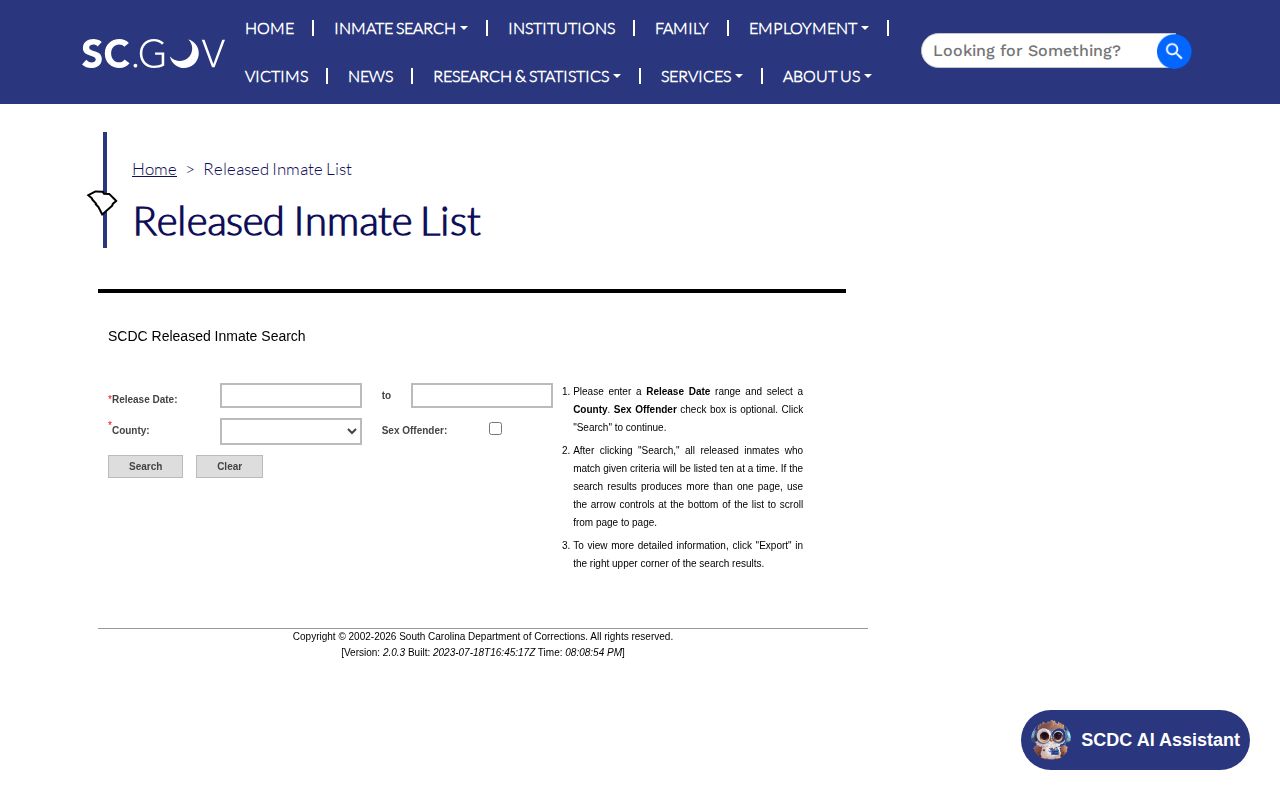
The county and date filters make it a state release tool, not a county-jail recent-release feed.
SCDC Projected Aiken Release Dates
An active SCDC record can display a projected-release field. The figure is computed, not promised. Good conduct or earned credits, loss of credits after discipline, court orders, detainers, and parole decisions may change it. South Carolina’s Title 24, Chapter 13 supplies the credit framework and an 85-percent floor for no-parole offenses.
SCDC’s release-date disclaimer explains the public calculator’s limits. Sentence questions go to the Inmate Records Office at 803-896-8531. The Aiken inmate release date page separates projected and actual dates and explains county-jail calculations.
| Source | Use |
|---|---|
| Current SCDC search | Active custody, institution, projected field |
| Released SCDC search | Completed release date and type |
| SCDPPPS | Parole, probation, or community supervision |
| SCDC records file | Audited sentence and final release documents |
SCDC Aiken Release Records
For a record beyond the public result, send a focused written request to FOIA@doc.sc.gov or the FOIA Coordinator, Office of General Counsel, South Carolina Department of Corrections, P.O. Box 21787, Columbia, SC 29221-1787. Include requester name, address, and phone. Ask for a final release authorization or certificate, date and type, sentence-computation or maxout audit, and photograph if public.
Posted charges are $0.10 per black-and-white page, $0.25 per color page, and $18.95 per hour for search, retrieval, and redaction. Deposit or prepayment may be required. Confidential personal information can be removed. SCDC policy OP-21.09 says the institutional file goes to the Inmate Records Office after release, is joined with the central file, and is later imaged or microfilmed. It does not publish one simple retention period for all former-inmate files.
SCDC FOIA CoordinatorOffice of General Counsel
P.O. Box 21787
Columbia, SC 29221-1787
FOIA@doc.sc.gov
After an Aiken SCDC Discharge
Observed Aiken release types included COMMUNITY SUPV, PROBATION, RELEASED, and RELEASE. These labels are not interchangeable. Community supervision or parole means custody has ended but supervision continues. Probation may flow from the sentence or a court disposition. A final discharge can end the relevant correctional term, though another case or authority may still matter.
SCDC Victim Services handles qualifying notifications and can address projected release, sentence completion, and court-order release channels. Its phone is 1-800-835-0304. SC VINE inquiry is 1-866-727-2846. If supervision follows, use Aiken Parole / Probation. The system boundary remains essential: an SCDC release says what happened in SCDC, not whether federal, immigration, or another county custody began.
Aiken State Release Types
The released list must be read by release type, not date alone. COMMUNITY SUPV signals a transition to a supervised stage. PROBATION points to court-ordered supervision. RELEASE and RELEASED report the state-system exit but do not describe every later obligation. A detainer indicator can signal that another agency was involved.
For a precise interpretation, compare the SCDC record with the sentencing docket and SCDPPPS search. The Aiken Public Index may show the court term or later order. SCDPPPS can address the current public supervision trail. None supplies the county jail physical departure record for a booking that never became SCDC custody.
Aiken SCDC Identity Matching
SCDC ID and SID are stronger identifiers than a name alone. Use them when reviewing an active record, released result, or written request. Name, age, sex, and race help distinguish people, but public data can contain common names or stale traits. The released list lacks name search, so narrow the county and date window first, then compare each row carefully.
A victim indicator or detainer indicator in underlying data needs context from the responsible agency. It should not be expanded into an unsupported claim. The most-serious-offense field is not a complete case history. For the controlling judgment, use the court record; for the sentence audit, use SCDC records.
SCDC Records After Aiken Release
OP-21.09 distinguishes institutional and central records. After release, the institutional record is forwarded to the Inmate Records Office and combined with the central file. Later imaging or microfilming supports continued retention, but the policy does not establish one public retention number for every former inmate. Expungement and state retention rules can change access.
A request should specify the final release document, sentence audit, public photograph if available, or another named record. South Carolina FOIA generally gives availability determinations within ten business days for newer records and twenty business days for older records. Those are records-process timelines, not immediate verification promises.
Interpret Aiken SCDC Release Codes
The released list must be read by release type, not date alone. COMMUNITY SUPV signals a transition to a supervised stage. PROBATION points to court-ordered supervision. RELEASE and RELEASED report the state-system exit but do not describe every later obligation. A detainer indicator can signal that another agency was involved.
For a precise interpretation, compare the SCDC record with the sentencing docket and SCDPPPS search. The Aiken Public Index may show the court term or later order. SCDPPPS can address the current public supervision trail. None of those records supplies the county jail’s physical departure record for a booking that never became SCDC custody.
Verify Aiken SCDC Identifiers
SCDC ID and SID are stronger identifiers than a name alone. Use them when reviewing an active record, released result, or written request. Name, age, sex, and race help distinguish people, but public data can contain common names or stale traits. The released list’s lack of name search means the county and date window must first be narrowed, then each row compared carefully.
A victim indicator or detainer indicator in underlying data needs context from the responsible agency. It should not be expanded into an unsupported claim. The most-serious-offense field is also not a complete case history. For the controlling judgment, use the court record; for the sentence audit, use SCDC records.
Preserve Aiken SCDC Release Records
OP-21.09 distinguishes institutional and central records. After release, the institutional record is forwarded to the Inmate Records Office and combined with the central file. Later imaging or microfilming supports continued agency retention, but the policy does not establish a single public retention number for every former inmate. Expungement and state retention rules can change access.
A request should avoid asking for confidential personal data that is not needed. Specify the final release document, sentence audit, public photograph if available, or another named record. South Carolina FOIA generally gives availability determinations within ten business days for newer records and twenty business days for older records, with longer production periods allowed by statute. Those are outer records-process timelines, not immediate release-verification promises.
Public Record Search
Sponsored Results